Contact


Journal of Indigenous Knowledge in Education
 |
|
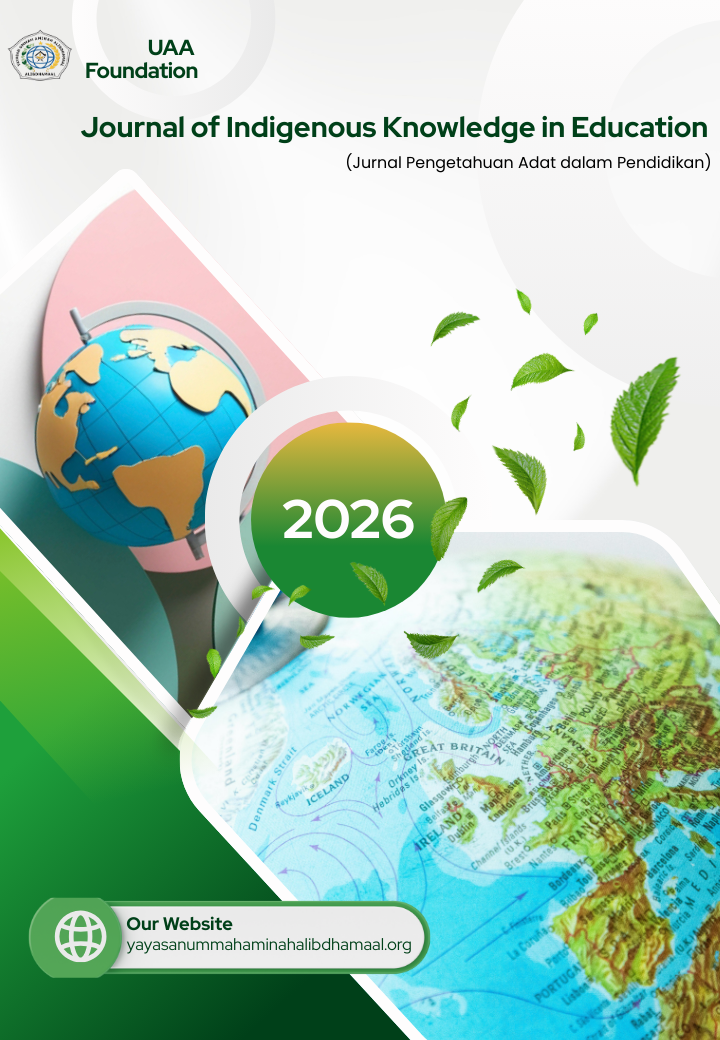
Journal of Indigenous Knowledge in Education (JIKE) is an open-access and peer-reviewed international scientific journal published by the Journal & Publication Development Center, Ummah Aminah Alibdhamaal Foundation, Indonesia.
JIKE publishes high-quality scholarly works that explore contemporary issues related to the integration of indigenous knowledge and local wisdom in education through interdisciplinary and multidisciplinary approaches. The journal welcomes contributions from various areas of educational studies, particularly those related to the role of local knowledge systems in educational theory, policy, and practice.
The scope of the journal includes, but is not limited to: indigenous knowledge in education, local wisdom-based learning, ethnopedagogy, culturally responsive teaching, community-based education, indigenous curriculum development, preservation of traditional knowledge through education, character education based on cultural values, and other relevant studies that connect culture, society, and education.
The journal is published twice a year, in May and November, and serves as an international academic forum for researchers, academics, educators, practitioners, and policymakers to disseminate original research articles, conceptual papers, literature reviews, and case studies. All submitted manuscripts undergo a rigorous and objective peer-review process to ensure academic quality, originality, and ethical integrity.
Journal of Indigenous Knowledge in Education (JIKE) is committed to promoting open access to scholarly knowledge in order to support the development of culturally relevant education, the preservation of indigenous knowledge, and global academic advancement.
| 1 Weeks | 1-4 weeks |
| Submission to first decision | Peer-review speed |
We are pleased to welcome you to the Open Journal System of the Journal of Indigenous Knowledge in Education (JIKE). JIKE is a peer-reviewed, open-access international journal committed to publishing high-quality scholarly articles focusing on the role of indigenous knowledge and local wisdom in education.
We understand that authors require a credible platform for disseminating their research and that readers expect reliable, rigorous, and impactful academic contributions. Therefore, JIKE aims to provide an academic forum where researchers, academics, educators, and practitioners can share knowledge, research findings, and innovative practices related to culturally responsive and indigenous-based education.
Our editorial board and reviewers are dedicated to maintaining the highest standards of academic quality, ethical publishing, and professional integrity at every stage of the publication process. All submitted manuscripts undergo a fair, objective, and rigorous peer-review process to ensure originality, relevance, and scholarly contribution.
JIKE strives to provide excellent publication services to the global education research community, particularly in advancing studies that integrate indigenous knowledge, local wisdom, culture, and education. To ensure transparency and punctuality, we openly present editorial information through journal statistics and periodically document our publication progress in the journal history, allowing authors and readers to monitor our performance and development.
The journal is published twice a year, in May and November, and welcomes contributions from researchers around the world.
We welcome inquiries regarding the journal’s scope, direction, and content. It is our hope that Journal of Indigenous Knowledge in Education (JIKE) will serve as a valuable source of knowledge, innovation, and inspiration for advancing educational research and practice worldwide.
All submissions must be free from plagiarism. JIKE upholds the highest standards of academic integrity and does not tolerate any form of academic misconduct, including plagiarism, data fabrication, falsification of data, or unethical authorship practices.





Content Use Policy

Journal of Indigenous Knowledge in Education (JIKE) is licensed under a CC-BY-SA
Email: intjournalalibdhamaal@gmail.com