Digitalisasi Layanan Bimbingan dan Konseling di Era Society 5.0
Tantangan, Peluang, dan Model TECH-BK
Keywords:
Guidance and counseling, digital technology, Society 5.0, e-counseling, TECH-BK modelAbstract
Objective
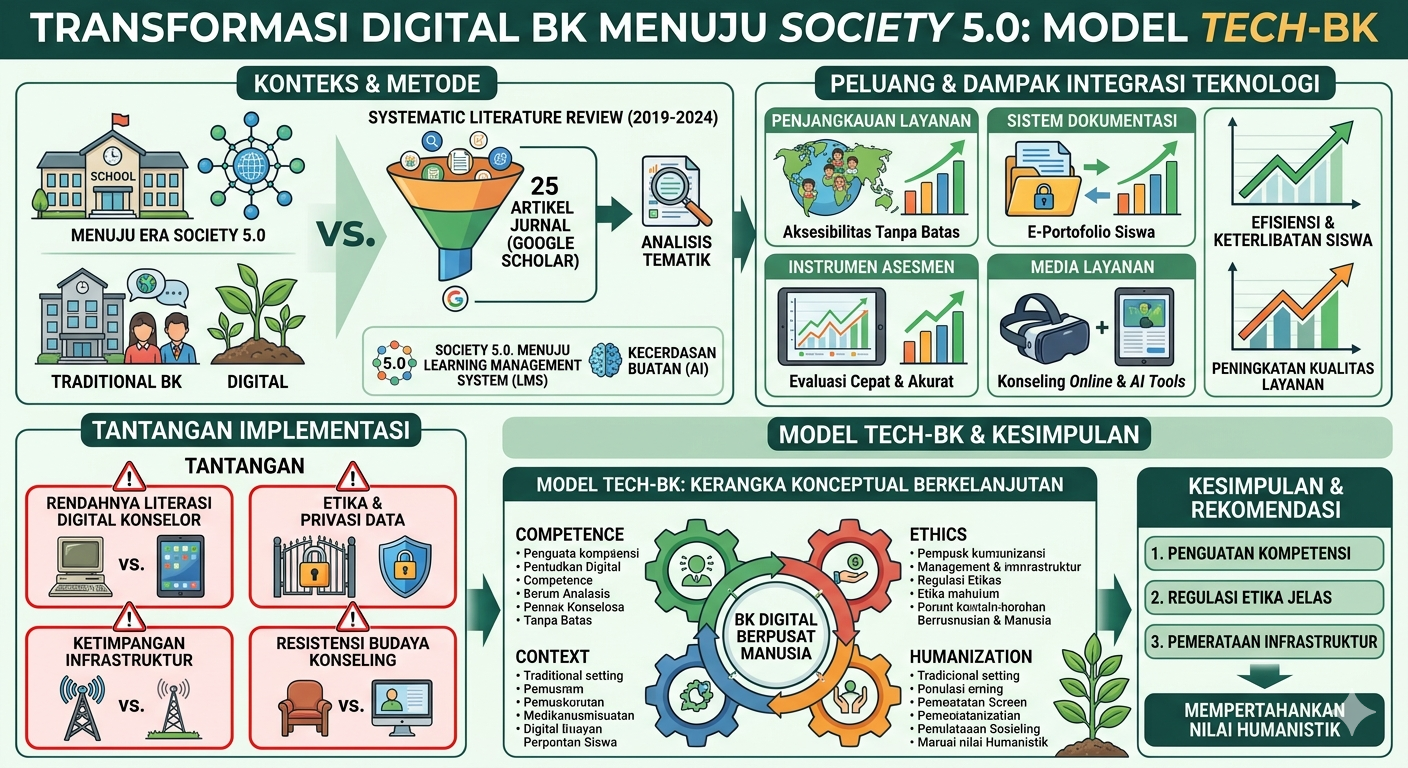
This study aims to analyze the digital transformation of guidance and counseling (BK) services in the Society 5.0 era, particularly regarding the opportunities, challenges, and implementation of the TECH-BK model in educational settings.
Method
This study employed a descriptive qualitative approach using a systematic literature review method. Data sources consisted of 25 national and international journal articles published between 2019 and 2024, indexed in Google Scholar. Data were analyzed using thematic analysis techniques adapted from Braun and Clarke to identify patterns related to digital transformation, implementation benefits, and emerging challenges in digital-based BK services.
Results
The findings reveal that the integration of digital technology in BK services has transformed four major aspects: service delivery media, documentation systems, assessment instruments, and service outreach. Digital counseling platforms, artificial intelligence (AI)-assisted tools, and learning management system (LMS) integration significantly improve service accessibility, counselor efficiency, documentation quality, and student engagement. However, several challenges remain, including counselors’ digital literacy gaps, ethical and data privacy concerns, unequal digital infrastructure, and cultural resistance toward online counseling practices. This study also proposes the TECH-BK model consisting of four pillars: competence, ethics, context, and humanization as a conceptual framework for implementing sustainable and human-centered digital counseling services.
Conclusion
The digitalization of BK services in the Society 5.0 era provides significant opportunities to enhance educational counseling services in Indonesia. Nevertheless, successful implementation requires strengthening counselors’ digital competencies, developing ethical regulations, improving technological infrastructure, and maintaining the humanistic essence of counseling practices. The TECH-BK model offers a contextual framework that can guide schools, counselors, and policymakers in implementing effective and ethical digital counseling services.
Downloads
References
Asosiasi Bimbingan dan Konseling Indonesia (ABKIN). (2021). Panduan etika konseling daring. ABKIN Press.
Asosiasi Penyelenggara Jasa Internet Indonesia (APJII). (2023). Profil internet Indonesia 2023. APJII.
Braun, V., & Clarke, V. (2006). Using thematic analysis in psychology. Qualitative Research in Psychology, 3(2), 77–101. https://doi.org/10.1191/1478088706qp063oa
Cabinet Office Japan. (2019). Society 5.0. https://www8.cao.go.jp/cstp/english/society5_0/index.html
Corey, G. (2021). Theory and practice of counseling and psychotherapy (10th ed.). Cengage Learning.
Fukuda, K. (2020). Science, technology and innovation ecosystem transformation toward Society 5.0. International Journal of Production Economics, 220, 107460. https://doi.org/10.1016/j.ijpe.2019.07.033
ABDİLLAH, H., SETYOSARI, P., LASAN, B., & MUSLİHATİ, M. (2020). The acceptance of school counselor in the use of ICT during school from home in the Covid-19 era. Journal for the Education of Gifted Young Scientists, 8(4), 1569–1582. https://doi.org/10.17478/jegys.804939
Alias, N. F., Mustafa, S. M. S., & Hamzah, L. M. (2022). Online Counselling Reach Out Services to Alleviate Stress among Students during Online Distance Learning. Asian Journal of University Education, 18(4), 954–965. https://doi.org/10.24191/ajue.v18i4.20005
Atmarno, T. W. S. (2021). Persepsi dan Sikap Konselor terhadap E-konseling: Potensi Implementasi dalam Program Konseling Komprehensif. Didaktika, 1(3), 510–527. https://doi.org/10.17509/didaktika.v1i3.40991
Braun, V., & Clarke, V. (2006). Using thematic analysis in psychology. Qualitative Research in Psychology, 3(2), 77–101. https://doi.org/10.1191/1478088706qp063oa
Fukuda, K. (2020). Science, technology and innovation ecosystem transformation toward society 5.0. International Journal of Production Economics, 220. https://doi.org/10.1016/j.ijpe.2019.07.033
Mishna, F., Milne, E., Bogo, M., & Pereira, L. F. (2021). Responding to COVID-19: New Trends in Social Workers’ Use of Information and Communication Technology. Clinical Social Work Journal, 49(4), 484–494. https://doi.org/10.1007/s10615-020-00780-x
Republika Indonesia. (2022). Undang-Undang Nomor 27 Tahun 2022 tentang Perlindungan Data Pribadi. Sekretariat Negara.
Salgues, B. (2018). Society 5.0: Industry of the future, technologies, methods and tools. John Wiley & Sons.
Situmorang, D. D. B. (2020). Online/Cyber Counseling Services in the COVID-19 Outbreak: Are They Really New? Journal of Pastoral Care and Counseling, 74(3), 166–174. https://doi.org/10.1177/1542305020948170
Supriyanto, A., Hartini, S., Irdasari, W. N., Miftahul, A., Oktapiana, S., & Mumpuni, S. D. (2020). Teacher professional quality: Counselling services with technology in Pandemic Covid-19. Counsellia: Jurnal Bimbingan Dan Konseling, 10(2), 176–189. https://doi.org/10.25273/counsellia.v10i2.7768
UNESCO. (2022). Reimagining our futures together: A new social contract for education. UNESCO Publishing.
World Health Organization. (2022). Mental health atlas 2020. WHO Press.
Wong, K. P., Bonn, G., Tam, C. L., & Wong, C. P. (2018). Preferences for online and/or face-to-face counseling among university students in Malaysia. Frontiers in Psychology, 9(JAN). https://doi.org/10.3389/fpsyg.2018.00064
Downloads
Published
Issue
Section
License
Copyright (c) 2026 Angelia Novi Grasela Sinaga, Agus Dina Romaulya siregar, Nurhidayah Sipahutar, Sahat Aryandi Saragih (Author)

This work is licensed under a Creative Commons Attribution-ShareAlike 4.0 International License.